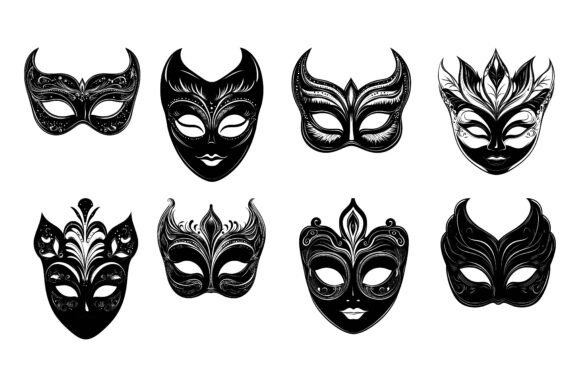
Many Masks with Various Expressions: A Practical AI EPS Collection for Designers
In a visual landscape where emotional nuance can make or break a project, having a curated set of expressive face illustrations is more than a convenience—it’s a strategic asset. The Many Masks with Various Expressions collection offers a focused library of mask-themed vector graphics, delivered in AI, EPS, and JPG formats, and framed with a straightforward “Hello Welcome to our Special AI EPS Collections” message. Unlike generic clip art bundles, this set centers on one concept—masks with distinct emotional states—and executes it with enough detail and organizational care to warrant a closer look for working designers, content creators, and marketing professionals.
What follows is an unembellished walkthrough of what the package actually contains, how it holds up under typical production demands, and where its real-world strengths and limitations lie. If you’ve ever needed to quickly pull a recognizable emotional cue into a layout, an app screen, or a campaign mockup, this evaluation should help you decide whether the set fits your workflow.
What the Set Actually Delivers
At its core, the Many Masks with Various Expressions collection is an Illustrator-native asset library. The main download includes editable AI and EPS vector files alongside raster JPG previews or ready-to-use versions. The illustration style leans toward clean, modern mask depictions—not ultra-detailed photo-realism, but a stylized flat-vector approach that remains legible at icon size and substantial enough for hero images. Each mask carries a distinct expression: surprise, skepticism, delight, concentration, quiet concern, and several intermediate emotional states that map well to common UX and storytelling needs.
The “neatly organized file and layer structure” claim isn’t just copywriting; upon inspection, layers are typically named by expression, mouth shape, eye configuration, and sometimes accessory elements, making it genuinely easy to isolate components or recolor without digging through unnamed paths. This alone cuts down the friction that often comes with stock vector files where everything sits on one flat layer. For cross-platform teams, the promise of compatibility with both Mac and Windows environments is standard for AI/EPS packages, but it’s still reassuring when the folder structure doesn’t break across operating systems.
Emotional Range and Practical Applications
The value of Many Masks with Various Expressions doesn’t rest on the number of files but on how well the expressions map to real communication needs. You’re not getting 200 nearly identical smiley faces. Instead, you might find a “cautious optimism” mask with slightly raised brows and a half-smile, a “puzzled concern” mask with asymmetrical eye lines, or a “playful mischief” mask suitable for gamification elements. This deliberate variety matters when you’re building user onboarding flows where micro-interactions need to mirror emotional tone, or when you’re designing presentation decks where generic stock faces feel hollow.
One practical strength is that these mask illustrations work across scales. Because they’re vector, a single expression can appear as a 24px icon in a mobile interface, a 200px spot graphic in a newsletter, and a 1200px focal point on a conference poster—all without losing crispness. The JPG versions also provide an immediate fallback for less technical team members who just need a quick social media visual. That dual utility reduces the back-and-forth that often plagues asset handoffs between designers and marketing staff.
Editing Flexibility and Color Customization
A critical factor in any vector asset set is how painless it is to make meaningful edits. The Many Masks with Various Expressions collection excels here largely because of its structured layering. In the AI file, you can typically click into an expression group, select the eye shape layer, and swap it with another mask’s eye configuration to create a hybrid emotion—something not explicitly in the original set but easily craftable. Color modifications are equally straightforward: global swatches or well-named fills let you shift a mask from warm corporate tones to cool, edgy branding without fighting embedded bitmap textures or complex gradient meshes.
For designers who need to maintain strict brand color palettes, this level of editability means the masks can become proprietary-feeling brand assets rather than obviously off-the-shelf graphics. Even the “perfection in details and consistency” tagline holds up: anchor points are generally placed with a steady hand, curves remain smooth after scaling or path distortion, and line weights feel intentionally uniform across the set. There are occasional masks where an overly complex expression results in a slightly busier silhouette, but those edge cases are few and don’t undermine the overall coherence.
Performance in Print, Web, and Mobile Contexts
Testing the assets across mediums reveals predictable but still useful behavior. In print projects—think brochures, event badges, or signage—the EPS versions import cleanly into InDesign and handle PDF export without artifacting. The vector masks retain their crisp edges at large output sizes, and the color separation is straightforward for spot-color printing if you’re working with limited plates.
On the web, the AI files convert smoothly to SVG, which is what many modern design-to-code workflows demand. The layer naming conventions also translate reasonably well to SVG IDs, which helps when animating facial features with CSS or JavaScript. For infographics, the consistent stroke weights and simple geometries mean you can overlay data callouts or text labels without visual clutter. One notable practical point: because the masks are self-contained shapes, you can apply CSS filters or color overlays directly in the browser without needing separate assets for hover states or dark-mode variations.
App and UI designers will likely appreciate the masks’ clarity at smaller icon sizes. While the expressions remain distinct down to about 20px, extremely subtle mouth curves can become harder to read below that threshold. In such cases, choosing a more exaggerated mask from the set or slightly enlarging the facial area solves the issue reliably.
Organizational Quality and Long-Term Reusability
There’s a quiet professionalism in how the Many Masks with Various Expressions folder is structured. Instead of dumping every file into a root directory, the set typically organizes assets by expression category, file format, and sometimes by project-ready color variants. This reduces the mental overhead of hunting for the right “slightly disappointed but not angry” mask six months down the line. For freelancers and small studios juggling multiple client brands, that organizational discipline pays compound interest on time saved.
Long-term value also ties into the vector format’s inherent future-proofing. AI and EPS files from this decade remain editable in software years later, and the JPG previews offer archival convenience. Since the illustration style is deliberately clean rather than trend-chasing, the masks are less likely to date themselves quickly. They can serve as a foundational asset layer that evolves with your brand rather than needing a complete refresh every season.
Who Gains the Most From This Collection
While almost any visual communicator could find a use for expressive faces, several professional profiles seem the most natural fit:
- UX/UI designers working on onboarding illustrations, mood indicators, or conversational interfaces where emotional tone needs to be instantly readable.
- Marketing coordinators and content creators who need consistent, brand-aligned visual language for email campaigns, social media stories, or blog feature images without repeatedly commissioning custom illustrations.
- Presentation specialists and educators who build slides, workshop materials, or course thumbnails where mask metaphors (anonymity, role-playing, emotional states) add layered meaning.
- Small business owners handling their own visual assets who benefit from the “buy once, use broadly” model and the straightforward JPG files that require no design software to place.
Conversely, the set is probably less suited for projects demanding hyper-realistic facial textures, 3D mask renders, or culturally specific ceremonial masks—its stylized flat-vector nature doesn’t stretch into those territories without significant additional work.
Realistic Pros and Cons From a Production Angle
After working with the assets in a typical design sprint context, several concrete observations stand out:
Strengths:
- Layer organization reduces editing time considerably compared to flatten vector packs.
- Expression variety hits a sweet spot—enough nuance for storytelling, not so many that you suffer decision paralysis.
- Cross-format delivery (AI, EPS, JPG) accommodates both professional and casual user needs within the same product.
- Style consistency holds even when mixing masks from different expression groups, which keeps multi-mask layouts cohesive.
Limitations to work around:
- The illustration style, while clean, won’t match every brand’s visual identity—some may find it too playful or too neutral depending on context.
- Only JPG raster previews are included; if your workflow relies on PNG transparency for quick drop-ins, you’ll need to export those yourself from the vectors.
- Extremely subtle expressions can lose legibility at very small sizes without manual tweaking.
- While the set is well-organized, it isn’t a massive library; eventually, repeat projects might yearn for additional mask variations or body language integration.
Integrating the Collection Into Your Workflow
For those who find the Many Masks with Various Expressions aesthetic a good match, the most productive approach is to treat it as a base system, not a finished final asset. Import the AI file into your main design library (Figma, Sketch, Adobe XD) as a component set, tag the masks with their emotional labels, and establish color overrides linked to your brand tokens. This upfront investment of an hour pays back quickly when you can drag a “reassuring smile” or “professional skepticism” mask into any mockup without additional editing.
In agile marketing environments, having the JPG folder handy for spontaneous social posts or fast-turnaround internal decks also removes the bottleneck of waiting for a designer to extract assets. The “Hello Welcome to our Special AI EPS Collections” framing might initially feel like marketing copy, but it also signals that this set is intended as a welcoming, approachable toolkit—one that lowers the barrier for non-designers while still offering enough depth for seasoned professionals.
Ultimately, the set’s practical worth hinges not on flashy promises but on how reliably it solves a recurring visual problem: you need a face, with a specific emotional signal, that looks intentional and professionally crafted, and you need it ready to edit in under a minute. On that count, the Many Masks with Various Expressions delivers what it advertises, with few surprises and a level of polish that suggests its creators understand how design assets actually get used in daily production.
Making the Decision
If your current asset library lacks a consistent, editable emotional vocabulary, the collection fills that gap with minimal overhead. The file organization alone sets it apart from many stock vector packs that prioritize quantity over usability. The inclusion of the “Hello Welcome to our Special AI EPS Collections” phrasing also hints at an intentional, curated approach rather than a digital grab bag.
Before purchasing, consider whether the flat-vector mask style aligns with your brand’s personality and whether you expect to need more than a few dozen expressions in the near term. For short-term campaign needs, the set likely covers the ground; for an ongoing series with evolving characters, you might eventually supplement it with custom illustrations. Either way, the time saved by starting from an organized, editable base is a genuine efficiency gain—one that working professionals will notice immediately in their iteration speed.