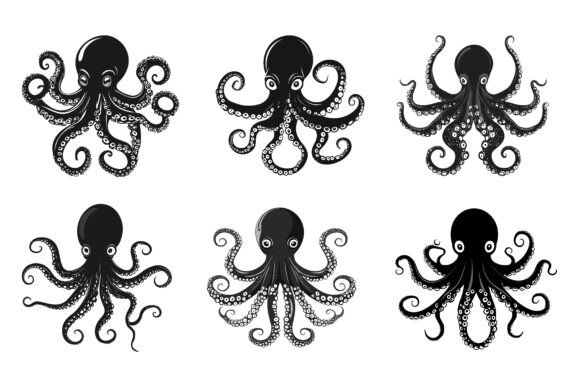
The Octopus Silhouette Set and How It Fits Into a Modern Creative Workflow
Finding the right visual element for a project often takes longer than expected. You scroll through libraries, test a few options, discard them because the lines don't feel right, and start over. An octopus silhouette set changes that dynamic by giving you a focused collection of shapes that are ready to deploy, yet flexible enough to adapt. Whether you're designing a logo concept, laying out an infographic, or building a set of icons for an app interface, having a cohesive group of silhouettes removes the friction of hunting for individual assets one at a time.
The octopus silhouette set mentioned here includes AI, EPS, and JPG files organized with intention. That format trio covers a lot of ground before you even open the first file. Vector formats mean infinite scaling without degradation. Raster formats give you quick previews and placeholder options. The combination speaks to a workflow where you might start rough in a raster editor, refine in vector, and export final assets without ever leaving a consistent visual language.
What Makes the Octopus Silhouette Set a Strong Starting Point
Silhouettes carry weight in design precisely because they strip away surface detail and leave only contour, gesture, and proportion. An octopus, with its eight arms and fluid body, offers curves, negative space, and a recognizable shape that reads clearly at any size. When you have multiple variations in one set, you can choose the posture or composition that best supports your message without commissioning custom work or tracing photographs.
This particular octopus silhouette set stands out for its attention to detail and structural consistency. The files are organized with a clear layer structure, which matters more than many people expect. Opening a vector file only to find unlabeled paths, grouped objects that don't ungroup cleanly, or layers named "Layer 1" through "Layer 47" adds unnecessary minutes to every editing session. A neatly arranged file lets you isolate individual elements, change colors, and modify shapes without accidentally disturbing adjacent artwork.
Where Silhouette Assets Fit Into a Broader Creative Process
Think about the stages of a typical design project. You start with research and concept development. Then you move into rough compositions. You refine, gather feedback, and polish. Throughout this sequence, the assets you rely on need to perform differently at each stage. During early layout, you might drop in a JPG preview of an octopus silhouette just to see how the shape interacts with your typography. During refinement, you switch to the AI or EPS file, adjust stroke weights or fills, and make the silhouette truly yours. By final export, the asset has become integrated into the larger piece rather than sitting on top of it.
Having a set that's deliberately built for this kind of progressive refinement saves time and keeps creative momentum flowing. You aren't stopping mid-project to search for a higher-resolution version or to rebuild a shape that only existed as a flattened image. The octopus silhouette set bridges those stages because the formats included anticipate the different demands of each phase.
Early-Stage Exploration and Rough Composition
In the early phase of a project, speed trumps precision. You want to test ideas, discard what doesn't work, and identify promising directions. Opening a JPG from the octopus silhouette set and placing it into a mood board or a rough layout takes seconds. You can see immediately whether the octopus shape complements your existing elements or competes with them. If the composition calls for something more compact, you try a different variation from the set. The assortment gives you enough range to explore without committing to heavy editing right away.
This exploratory phase is also where you assess how the silhouette interacts with other assets in your library. An octopus shape might pair unexpectedly well with geometric patterns, nautical themes, or abstract backgrounds. Because the silhouette is a unified visual object with a clear outline, it tends to create strong figure-ground relationships. That clarity makes it easier to judge whether your layout has the right balance before you invest hours in detail work.
Refinement and Customization
Once you've settled on a direction, the vector files become your primary working documents. AI and EPS formats open in industry-standard software like Adobe Illustrator, Affinity Designer, CorelDRAW, and a range of other vector editing tools across both Mac and Windows. The cross-platform compatibility means you aren't locked into a specific operating system or application, which is especially relevant if you collaborate with others who use different setups.
Editing the octopus silhouette is straightforward because of the organized layer structure. Want to change the fill color to match a brand palette? Select the layer and apply the new color. Need to modify a tentacle's curve to better frame a headline? Use the direct selection tool and adjust the anchor points. The original designer built these files with editing in mind, so the paths are clean, the anchor points are placed sensibly, and the grouping makes logical sense. This isn't always the case with stock vector files, where complex clipping masks and poorly constructed paths can turn a simple color change into a tedious exercise.
The emphasis on easy modification also means the octopus silhouette set can evolve with your project. A single silhouette might start as a solid black shape, become a white knockout on a dark background, and eventually turn into a subtle watermark or a patterned element. Each transformation depends on the underlying structure being built correctly from the start.
Practical Applications Across Different Media
The versatility of a well-constructed silhouette set becomes apparent when you look at the range of outputs it supports. Print projects demand high resolution and clean lines that reproduce faithfully on paper. Web projects need scalable graphics that look sharp on retina displays and load efficiently. App icons and interface elements require simplicity and legibility at very small sizes. Infographics call for visual metaphors that communicate quickly. The octopus silhouette set claims suitability across all these contexts, and that's a realistic claim when the source files are vector-based and well-organized.
- Print materials: Posters, flyers, brochures, and packaging benefit from the crisp edges that vector silhouettes provide. An octopus shape can serve as a striking focal point or a subtle background motif that adds texture without distracting from the main message.
- Web and digital design: SVG exports from the AI or EPS files produce lightweight, resolution-independent graphics for websites, email templates, and social media graphics. The octopus silhouette can anchor a hero section, frame a call-to-action, or appear as part of a larger illustration system.
- App and UI elements: Silhouettes translate well to icons, buttons, and navigational symbols. The octopus shape, while distinctive, can be simplified further or combined with other elements to represent categories, features, or branded interactions.
- Infographics and data visualization: An octopus silhouette can represent complexity, interconnectedness, or adaptability in a visual metaphor that viewers grasp quickly. Positioned alongside charts, graphs, or statistical callouts, it adds a conceptual layer without overwhelming the data.
Consistency and Quality Control in Reusable Asset Collections
One underappreciated aspect of working with a cohesive silhouette set is the consistency it brings across multiple projects. If you use a single octopus silhouette from a random source for one project and a different octopus illustration from another source for a second project, the stylistic mismatch can undermine your brand or portfolio's visual coherence. A dedicated set, created by one designer with a unified approach, eliminates that variable.
The attention to detail and perfection in consistency that this octopus silhouette set promises means each variation shares the same line weight sensibility, the same level of simplification or complexity, and the same overall aesthetic. When you place two variations from the set side by side, they look like they belong together. When you use one variation in a logo and another in a supporting graphic, the relationship between them reads clearly. This internal coherence reduces the mental overhead of mixing and matching assets and leads to more polished final deliverables.
Integration With Other Tools, Platforms, and Team Workflows
Design assets rarely exist in isolation. The octopus silhouette set interacts with your existing toolkit in ways that depend on how you set up your projects. If you work in Adobe Creative Cloud, the AI and EPS files integrate natively with Illustrator and can be imported into Photoshop as smart objects, maintaining their vector properties and editability. If you use Figma or Sketch for UI work, you can import the vector paths and continue editing within those environments. If your workflow leans toward open-source tools like Inkscape, the EPS format provides a reliable bridge.
For teams, organized files reduce the back-and-forth that happens when someone opens an asset and can't figure out how to isolate a particular element. A clean layer structure with descriptive naming conventions means a designer can hand off a file to a colleague or client, and that person can make basic modifications without a lengthy orientation. This matters especially in deadline-driven environments where a bottleneck around asset preparation can delay an entire project timeline.
Long-Term Use and Asset Management
Purchasing an illustration set represents an investment in reusable creative material. Unlike a one-off commissioned illustration that serves a single purpose, the octopus silhouette set becomes part of your permanent asset library. The files sit on your hard drive or cloud storage, ready to be opened next quarter or next year when a new project calls for ocean-inspired imagery or an abstract visual metaphor involving complexity and adaptability.
To make the most of this long-term value, consider how you organize your purchased assets. A clear folder structure with the original files preserved in their purchased state, alongside a separate folder for modified versions, prevents accidental overwrites and gives you a fallback if an edit goes wrong. Because the octopus silhouette set comes with AI, EPS, and JPG formats, you might create subfolders for each format type or organize by project where you've used the assets. A small amount of upfront organization pays dividends each time you return to the collection.
Who Benefits Most From This Type of Resource
The octopus silhouette set appeals across a broad spectrum of users because its core value—quick access to editable, high-quality vector shapes—translates to many different contexts. Graphic designers use silhouettes as base elements in branding, editorial layouts, and advertising materials. Web designers incorporate them into page layouts and interactive elements. Small business owners without formal design training appreciate being able to customize the colors and sizes without needing advanced illustration skills. Educators and presenters use silhouettes in slide decks and learning materials where clear visual metaphors support comprehension.
Bloggers, content creators, and social media managers find silhouette sets useful for creating consistent visual content without starting from scratch each time. A blog post about marine biology, a podcast cover, or an Instagram story can all draw from the same octopus silhouette set while adapting the colors, composition, and context to fit the specific platform and audience.
Entrepreneurs and small business owners who handle their own marketing materials often face a gap between the professional look they want and the time or budget they have for custom design. A ready-to-use illustration set bridges that gap effectively. The ability to change colors and modify shapes means the octopus silhouette can be tailored to match existing brand assets rather than looking generic or off-the-shelf.
Making the Purchase Decision With Confidence
When evaluating whether a digital illustration set fits your needs, consider the formats, the organization, and the editability as primary decision criteria. The octopus silhouette set addresses each of these explicitly. AI and EPS formats provide the vector foundation. JPG files offer quick raster previews and small-file-size alternatives for situations where vectors aren't necessary. The cross-platform design means the set works whether your computer runs macOS or Windows, and it plays nicely with a wide range of professional and hobbyist design applications.
The organized layer structure and attention to detail suggest that the creator built these files with an understanding of how designers actually work. Paths that are easy to select, modify, and recolor save real minutes per editing session. Multiplied across dozens of projects, those minutes add up to a significant return on a modest purchase price. The suitability across print, web, symbols, apps, and infographics means the set isn't pigeonholed into a single use case, expanding its practical value.
Practical Tips for Getting Started Immediately
Once you've acquired the octopus silhouette set, resist the urge to open every file at once and browse aimlessly. Instead, open one vector file that matches a current or upcoming project and spend ten minutes experimenting with modifications. Change the fill color to a brand color. Adjust the size and see how the shape holds up at thumbnail scale and at poster scale. Try exporting a small JPG and a PNG with transparency to understand the output options available to you.
If you're new to vector editing, start with simple color changes before moving on to path modifications. Many designers find that even basic adjustments—swapping a solid black fill for a gradient, adding a stroke outline, or converting the silhouette to a knockout on a colored background—produce dramatically different results that feel custom rather than cookie-cutter. The learning curve is shallow by design because the underlying files are built to be approachable.
For more experienced users, the octopus silhouette set can serve as a jumping-off point for more complex compositions. Duplicate a silhouette, scale it, rotate it, and change its opacity to create depth. Combine it with typography to build a lockup or logo concept. Use it as a clipping mask for photographic textures. The vector foundation supports all of these techniques without degradation, and the clean path construction means the results will look intentional rather than messy.
Ultimately, a well-crafted illustration set earns its place in your workflow by being dependable, adaptable, and consistently available when you need it. The octopus silhouette set, with its range of formats, cross-platform compatibility, organized structure, and editability, fits that description. It's a practical resource that respects your time and your creative process, and it's ready to be put to use the moment you download the files.