Politics Icons: A Practical Visual Toolkit for Modern Communication
Visual language shapes how audiences interpret information before they read a single sentence. When you work in civic education, policy analysis, campaign media, or any field that touches governance and public affairs, finding the right icon set can save hours of design time while improving clarity. Politics Icons addresses a specific gap that many generic icon libraries overlook—the need for clean, recognizable symbols that represent political concepts without leaning too far into caricature or oversimplification.
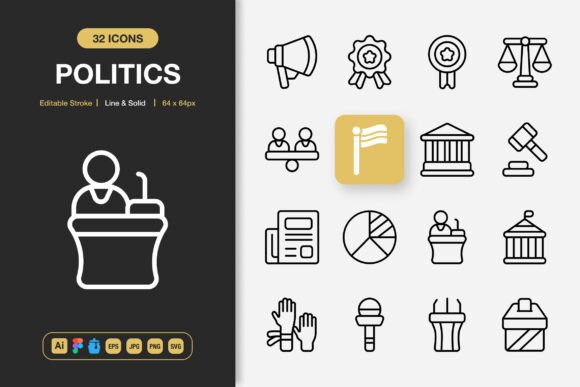
What separates this collection from broader symbol libraries is the deliberate focus on political and governmental themes while maintaining a neutral visual tone. You will find representations of voting, legislation, leadership, diplomacy, debate, and civic engagement rendered in a way that works alongside professional layouts rather than competing with them. The designers clearly understood that political imagery carries weight and needs to communicate without unnecessary embellishment.
What the Set Actually Contains
This is not merely a handful of ballot boxes and capitol buildings. The collection spans a broad range of political and governance-related concepts, covering election processes, institutional roles, policy tools, and abstract democratic principles. Within the downloaded package, you receive multiple file formats that accommodate vastly different workflows:
- Adobe Illustrator source file for complete editing control over every vector point
- Figma file for teams working in browser-based design environments
- IconJar file for those who organize assets through icon management software
- EPS Version 10 ensuring backwards compatibility with older design applications
- SVG files ready for web implementation and responsive scaling
- PNG with transparency for quick placement in presentations, documents, and basic layouts
- JPG files for scenarios where flattened raster images are preferable
- Readme.txt with straightforward guidance on usage and attribution
The inclusion of both line and solid style variants deserves attention. Line style icons offer a lighter visual footprint suitable for editorial layouts, government reports, and academic publications where subtlety matters. Solid style versions carry more visual weight and work effectively in navigation elements, call-to-action buttons, and infographics where you need icons to anchor a section. Having both options from a single source means you avoid the jarring inconsistency that happens when mixing styles from different designers.
Quality and Editability in Practice
Anyone who has downloaded free icons only to discover they cannot adjust stroke widths or modify curves knows the frustration of locked-down assets. The editable stroke feature in this set resolves that limitation. You can thicken lines for smaller display sizes, thin them for large-format prints, or adjust terminals to match a specific brand's visual language. This level of customizability is particularly valuable for political organizations and advocacy groups that need to maintain strict visual identity guidelines while still using recognizable iconography.
The high-quality vector construction means these shapes hold up at any scale. A capitol dome icon should look sharp on a business card as well as a conference backdrop banner. Testing across devices and print formats reveals clean rendering without awkward anchor points or uneven curves—details that separate professionally crafted icon sets from hastily assembled alternatives.
Customization extends beyond stroke adjustments. The source file structure allows you to recolor entire icon families to match brand palettes, isolate specific elements for modification, or combine components to create new symbols that inherit the same visual DNA. A campaign designer could take the voting icon, adjust colors to match candidate branding, and maintain complete design consistency across every touchpoint—from social media graphics to yard signs.
Websites and Digital Platforms
Political journalism sites, civic tech platforms, advocacy portals, and candidate websites all benefit from iconography that visitors immediately understand. SVG format enables smooth scaling across desktop browsers and mobile screens without pixelation. The simplicity of the designs also aids page load speed since clean vector paths typically result in smaller file sizes compared to overly complex illustrations. A policy think tank could use these icons throughout a research portal to categorize reports by topic area—budget appropriations, healthcare legislation, environmental regulation—without the icons distracting from the content they accompany.
Mobile Applications
Apps focused on voter information, legislative tracking, or civic engagement rely heavily on visual navigation cues. These icons work at the compact sizes required for mobile interfaces while maintaining legibility. The consistent proportions across the entire set prevent the common problem where one icon appears dramatically larger or denser than its neighbor in a tab bar or menu.
Printed Materials and Publications
Books on political science, government textbooks, policy briefs, and printed reports all benefit from unified icon systems. Because the icons are vector-based, they reproduce cleanly in offset and digital printing environments. Line style variants particularly suit academic and literary contexts where bold graphics might feel inappropriate. A university press publishing a comparative politics textbook could integrate these icons into chapter headings and margin notes without undermining the scholarly tone.
Data Visualization and Infographics
Infographics that explain electoral systems, government structures, or policy comparisons demand icons that sit comfortably alongside charts and statistical displays. The geometric discipline of these icons means they align well with data visualization components like bar charts, flow diagrams, and proportional graphics. A nonprofit organization explaining voter turnout trends across demographics could place relevant icons next to statistical callouts, strengthening the connection between data points and real-world meaning.
Social Media and Campaign Assets
Campaigns, advocacy groups, and civic educators operating on social platforms need visually consistent content that loads quickly and reads clearly at feed sizes. JPG and PNG formats facilitate rapid posting workflows, while the SVG versions support animation and interaction for more sophisticated digital campaigns. A local government office running a voter registration drive could produce a series of posts where consistent icon usage reinforces the message across multiple platforms and formats.
Drag-and-Drop Integration and Workflow Speed
The easy drag-and-drop functionality is not simply marketing language—it reflects practical file organization that respects how designers actually work. Icons are typically organized by category and available in both style variants without requiring you to hunt through nested folders or decipher cryptic file naming schemes. For teams producing time-sensitive materials—election night social graphics, breaking policy announcements, rapid-response campaign assets—this organization translates directly into faster turnaround times.
The inclusion of IconJar format further streamlines workflows for teams that manage large asset libraries. Instead of pulling individual files from Finder or Explorer, designers can search, preview, and drag icons directly into Sketch, Figma, or Adobe applications. This matters when multiple team members need consistent access to the same icon set across different projects and timelines.
Who Gains the Most Value
Several audience segments will find this collection particularly useful. Political campaign consultants and communications directors can build entire visual systems around a unified icon set, maintaining consistency from direct mail pieces to digital ads. Government communications professionals who produce public information materials will appreciate the neutral, authoritative visual voice that avoids partisan signaling. Policy researchers and think tank analysts creating data-rich publications can use these icons to structure complex information hierarchies. Educators developing civics curricula and textbook designers building chapter navigation systems both benefit from symbol sets that students can interpret quickly.
Freelance designers juggling multiple political and advocacy clients gain efficiency by standardizing on a single well-built icon set rather than hunting through disparate free sources for each new project. Nonprofit communications teams working on voter education, government accountability, or civic participation campaigns can establish visual consistency across grant reports, annual reviews, social media, and event materials.
Realistic Considerations and Potential Constraints
No single icon set covers every conceivable political concept across every cultural and governmental context. Political systems vary enormously worldwide, and icons designed primarily around recognizable governmental structures may require supplementary customization for regional specificity. A designer working on materials for a parliamentary system might need to adapt certain visual metaphors to better match local institutional realities. This set provides the editable source files that make such adaptations feasible, but the initial designs should be evaluated against your specific communicative needs.
Also consider that highly specialized political subfields—comparative constitutional law, intricate electoral mathematics, regulatory compliance frameworks—may require custom iconography beyond what any general political icon set provides. View this collection as a strong foundation that covers common political and civic concepts, supplemented when necessary by custom-designed additions that follow the same visual logic.
Long-Term Value in a Changing Political Media Landscape
Political communication evolves rapidly, but the fundamental visual metaphors—voting, representation, debate, legislation—remain remarkably stable. Investing in a well-constructed icon set means building an asset library that serves materials across election cycles, policy windows, and institutional changes. The editable nature of the source files future-proofs your investment; as brand guidelines shift or design trends evolve, you can update strokes, colors, and proportions without relicensing or recreating assets from scratch.
For organizations producing documentation that spans years—government archives, longitudinal research studies, institutional histories—maintaining visual consistency becomes a marker of credibility and professionalism. Pulling the same icon set consistently across 2025 policy briefs and 2028 retrospective reports signals methodological rigor and institutional continuity, whether audiences consciously register that consistency or not.
Integration with Common Design Ecosystems
The file format variety ensures compatibility across virtually every professional design environment. Adobe Creative Cloud users get native Illustrator files plus EPS for older workflows. Figma users receive a dedicated file that integrates with component libraries and team collaboration features. Developers implementing web designs can pull SVG files directly into codebases for inline rendering or spritesheet compilation. Document designers working in Microsoft Office or Apple Keynote can use PNG versions for quick placement without wrestling with unsupported vector formats.
This breadth of format support reduces friction when passing assets between team members who use different tools. A freelance designer working in Illustrator can hand off SVG exports to a developer, PNG placeholders to a project manager building presentation decks, and the original Figma file to a product designer—all from the same initial download.
The Politics Icons collection earns consideration not through novelty but through practical utility. It respects the constraints that professional communicators navigate daily—tight timelines, brand consistency requirements, multi-format delivery needs, and the ever-present demand that visual elements enhance rather than distract from substantive political content. For projects where political and civic themes demand clear visual language, this set provides a reliable foundation adaptable enough to serve across websites, mobile interfaces, print publications, and social platforms alike.