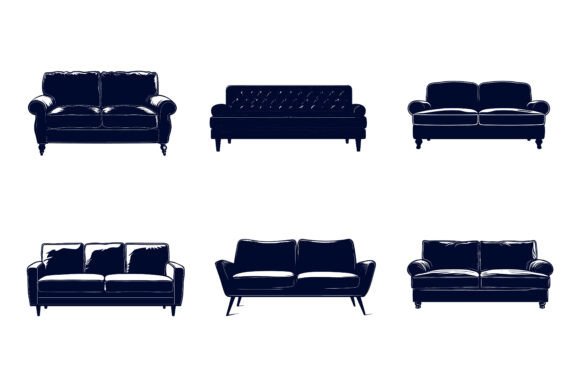
Different Couches and Armchairs Set: Ready-to-Use Vector Illustrations for Real Projects
You know that moment when you need a furniture graphic that looks consistent, scales cleanly, and doesn’t force you to redraw every cushion from scratch? That’s the gap this Different Couches and Armchairs Set fills. It’s a curated collection of couch and armchair illustrations delivered as AI, EPS, and JPG files, built for both Mac and Windows users. The set doesn’t just give you outlines. It hands you neatly organized layers, precise detailing, and a design consistency that makes the assets work across print, web, app interfaces, infographics, and symbol creation.
Instead of treating these as generic clip art, the files are structured so you can change colors, tweak shapes, and pull out individual elements in minutes. Whether you’re designing a real estate flyer, building a furniture catalog mockup, or creating an interior design mood board for a client, the real value sits in that adaptability. You aren’t locked into a single sofa silhouette; you get a range of styles that can slide into different visual languages without looking mismatched.
A Quiet Time-Saver for Designers and Non-Designers Alike
Downloadable illustration sets often suffer from two problems: chaotic file names and layers that look like a digital junk drawer. The Different Couches and Armchairs Set avoids that headache. Every file follows a logical naming convention, and the layer structure inside the AI and EPS versions is easy to navigate. For someone who isn’t a trained illustrator—maybe a marketer throwing together a social post or a blogger creating a “10 Cozy Living Room Layouts” article—that organization means you spend less time hunting for the right armrest curve and more time assembling your composition.
A freelancer juggling multiple brand kits will immediately appreciate how the neatly organized file and layer structure speeds up color swaps. Want that mid-century armchair in the exact teal from a client’s palette? Open the file, isolate the shape, and apply the hex code. No need to ungroup a hundred stray paths. This kind of detail is often missing from bulk icon packs, but here it’s a deliberate part of the collection’s design.
Where These Illustrations Show Up in Daily Work
Real-world use cases for a couch and armchair set extend far beyond a furniture store’s website. A small business owner opening a home staging service might drop the sofa illustration onto a service flyer, pairing it with a before-and-after photo to visually communicate transformation. An interior design student preparing a digital pinboard can drag the JPG files right into a presentation without worrying about resolution, since the vector originals maintain crisp edges at any size.
Bloggers who write about apartment styling often need featured images that feel cohesive. Instead of grabbing mismatched stock photos, they can create a series of header graphics using the same armchair in different room settings, only changing the background and accent colors. This builds a recognizable visual thread across posts. Similarly, a YouTube creator who covers small-space furniture hacks can turn the EPS files into on-screen icons that pop up during key tips, keeping the video tidy and branded.
Why Print and Web Projects Both Benefit
One of the quiet frustrations in hybrid workflows is preparing assets that look equally sharp on a billboard mockup and a mobile screen. The inclusion of AI, EPS, and JPG versions in this set means you don’t have to run conversions through multiple tools. The vector formats (AI and EPS) give you infinite scalability for large-format printing—think trade show banners, window decals for a furniture boutique, or even custom-printed cushions that feature the illustrations themselves. The JPG versions, on the other hand, drop straight into blog posts, email newsletters, and social media templates without any extra steps.
An app developer building a room-planning tool can take these illustrations and reduce them to simple icons or interface symbols because the linework is already clean and consistent. The same set that appears in a printed catalog can shrink down to a 24-pixel button without losing legibility. That kind of cross-medium flexibility saves you from hunting down separate assets when a project unexpectedly shifts from digital to print, or vice versa.
Editing Without Breaking a Sweat
Editable vector files are only as good as their construction. If a file looks beautiful but falls apart the moment you try to move a cushion, it’s practically useless for iterative design work. In this collection, each couch and armchair is built with perfection in details and consistency. You can isolate a single throw pillow, adjust its curvature, or recolor the entire seat section without distorting adjacent parts. The visual language stays uniform from the classic rolled-arm sofa to the sleek modern accent chair, so a composite infographic about living room trends won’t feel like it’s borrowing from three different artists.
Let’s say you’re designing an e-book about home organization. You want to use the armchair illustration as a recurring chapter icon, but each chapter has its own accent color. You open the AI file, group the chair, and copy it across pages, applying a new fill each time. Because the layers are intuitive, you can even delete the legs if you only need the seat silhouette. This degree of control matters when you’re not just decorating a page but building a visual system.
Realistic Scenarios That Highlight the Set’s Strengths
Imagine a marketing coordinator at a furniture rental company. They need to send out a promotional email featuring five living room setups, but actual product photos haven’t arrived from the warehouse yet. Instead of delaying the campaign, they pull couch and armchair illustrations from this set, arrange them into stylized room sketches, and pair them with text overlays. The email launches on time, and the illustrations actually give it a distinctive illustrated-catalog feel that stands out in crowded inboxes.
Or picture a teacher creating a printable worksheet for an interior design elective. They want students to experiment with room layouts on paper, so they drop the JPG versions of sofas and chairs onto a grid. Students can cut them out and rearrange without needing software. The illustrations are realistic enough to discuss proportion and style, yet simple enough not to distract from the learning objective.
Even a stationery designer making custom notecards can find a place for these assets. A single elegant armchair centered on a card, printed on textured paper with a subtle color change, becomes a thoughtful thank-you note for an interior design client. The set lends itself to these micro-projects precisely because it’s clean and editable.
What to Consider Before You Download
Before grabbing any illustration set, ask yourself about compatibility and workflow. You want files that open seamlessly in your preferred software—this collection supports both Mac and Windows environments, and the AI/EPS formats play well with Adobe Illustrator, Affinity Designer, CorelDRAW, and even free vector apps like Inkscape. The JPG files are universal, so even if you don’t touch vectors, you still have immediate access.
Check whether the style aligns with the mood you need. The Different Couches and Armchairs Set leans toward detailed yet adaptable illustrations, meaning they can look polished in a high-end furniture brochure or feel approachable on a hobby blog. However, if your project requires ultra-minimalist line art with no interior detail, you might need to strip back some layers—something the organized structure actually makes easier. The key is that the set isn’t rigid; it gives you a solid foundation you can modify quickly.
Also think about scalability in terms of project volume. If you’re building a large library of recurring visuals—like a website that features dozens of room types—having a consistent source for seating elements prevents visual fragmentation. Instead of re-sourcing couches every time you start a new page, you can pull variations from the same family of illustrations. The neatly organized file and layer structure keeps that process fast, even at scale.
Turning Features into Practical Results
It’s easy to read a list of bullet points like “AI EPS and JPG included” and gloss over the practical meaning. But when you’re late on a project and you realize you can drop a JPG directly into a Canva template without converting anything, that’s a friction point eliminated. When you need to match a brand’s coral accent color and you can change the couch’s hue in two clicks instead of twenty, that’s tangible speed. The file compatibility isn’t just a spec; it’s an open door for people who work across different tools daily.
The set’s suitability for print, web, symbols, apps, and infographics also translates into fewer repurchases. You don’t need one couch graphic for your business card and another for your website header. You can scale the same vector up and down without pixelation, retaining the identical shape language. This visual consistency reinforces your brand or project identity quietly but effectively.
How Different Users Find Their Own Angle
A hobbyist crafting a personalized family room print for their home might never open the EPS file; they’ll use the JPG and be done. A freelance graphic designer will dive into the AI layers to create a unique sofa icon set for a client’s UI. A blogger might use the illustrations as base imagery for Pinterest pins, layering text and filters. A small furniture store owner may place them on product hangtags, shrinking them down to a tiny logo-like mark. Each person engages with the same collection differently, and the set doesn’t force a single path.
What makes this Special AI EPS collection noteworthy isn’t flashy technology or a massive file count. It’s the quiet discipline behind the construction—every anchor point placed with purpose, every layer named sensibly, every curve refined so that when you drop the illustration into your own context, it simply fits. That reliability becomes part of your workflow rather than a stumbling block.
When you’re working on deadline or building a visual identity that needs to stay coherent across mediums, having a folder of assured, editable furniture graphics changes your pace. You move faster, you experiment more freely, and you spend less mental energy on fixing someone else’s sloppy vector work. The Different Couches and Armchairs Set earns its place in your toolkit by being prepared for situations you haven’t even mapped out yet.