Soccer Players Running with Ball: Mastering Movement, Control, and Dynamic Design
The Pulse of the Game When Feet Meet Speed
Few sights in sport ignite excitement quite like a player bursting into open space, the ball glued to their feet as they carve through defensive lines. Soccer players running with ball represent the game’s most thrilling transition moment—the instant a controlled first touch becomes a full-throttle attack. This action is not simply about pace; it’s a delicate fusion of biomechanics, spatial intelligence, and razor-sharp decision-making. At youth levels, kids naturally chase the sphere, but elite performers transform a basic run into a weapon, shifting body weight, altering stride patterns, and scanning the field without breaking stride.
Modern analysis breaks this movement into distinct phases: reception, acceleration, sustained dribble, and exit decision. The foot’s contact surface changes from laces for speed to the instep or outside edge for subtle directional nudges. Coaches emphasize that head orientation matters just as much as leg movement. The best runners see not just the ball but two moves ahead, mapping defender positions and passing lanes while maintaining fluidity. This split-second multitasking is what separates functional carriers from game-changing dribblers.
Why Ball Carrying Defines Match Tempo
When soccer players run with the ball, they force the opposition to make uncomfortable choices. Defenders must decide: step up and risk being beaten, or drop off and allow possession to advance into dangerous zones. This hesitation creates pockets of space for teammates. A single 20-meter carry can bypass an entire midfield press, turning a defensive clearance into a counter-attack in seconds. Statistics now track “progressive carries”—runs that move the ball significantly toward the opponent’s goal. Teams that dominate this metric often control the game’s rhythm, exploiting gaps before organized defensive shapes can form.
Interestingly, the art of running with the ball is not limited to the flanks. Central players who can surge through the spine of the pitch—think of a deep-lying midfielder breaking forward—disrupt set defensive blocks. They draw multiple markers inward, opening wide areas for overlapping fullbacks or inverted wingers. The psychological impact on the opposition cannot be overstated. A confident carry signals intent and can deflate a pressing unit, forcing them to reconsider their aggressiveness.
Technical Breakdown: Anatomy of an Effective Carry
Executing a high-speed dribble demands refined technique. Unlike stationary ball control, running introduces momentum that must be managed with each touch. Players learn to keep the ball within a radius that allows immediate reaction if a tackle arrives, yet far enough to avoid tripping. The body’s center of gravity drops slightly, arm movement becomes a counterbalance, and the supporting leg plants with a precision that stabilizes the frame for the next push.
Touch Rhythm and Ball Distance
Optimal touch frequency varies by context. In open space, longer touches every three to four strides maintain top velocity. Under pressure, shorter, more frequent contacts keep possession tight. Elite ball carriers develop an intuitive sense of when to push the ball ahead and when to shield it. They also master feints—a drop of the shoulder or a stutter step—to freeze defenders without losing momentum. Soccer players running with ball at full stride often layer in these deceptive cues, making their path unpredictable even at high speed.
Vision and Peripheral Awareness
The head must lift intermittently. A common coaching mantra is “check your shoulder before you receive, and check again while you travel.” Peripheral vision tracks nearby opponents, while a quick glance at the horizon reveals shifting formations. Training slalom poles and mannequins helps, but the real skill develops through small-sided games where constant scanning becomes second nature. The ability to run, see, and plan simultaneously is what turns a simple carry into a launchpad for an assist or shot.
Legendary Examples and Their Signature Runs
Soccer history lights up when iconic names are associated with breathtaking solo marches. From Diego Maradona’s slaloms through dense English defenses to Lionel Messi’s low-center-of-gravity zig-zags past countless defenders, the archetype of the ball carrier evolves but never fades. Modern fullbacks like Alphonso Davies exemplify pure athletic carrying—eating up ground at remarkable speed, often from deep in their own half. Each legend adds a unique flavor: the direct explosiveness, the tight-space wizardry, or the long, rolling stride that covers half the pitch.
These players demonstrate that running with the ball isn’t merely a physical feat. It’s a statement. It communicates confidence, disrupts tactical structures, and connects directly with fans. Youth players watching these stars internalize the dream of their own dazzling run, which makes resources depicting the action so valuable for education and inspiration.
Training Drills to Elevate Ball-Carrying Performance
Developing this skill requires drills that replicate match chaos. Cone weave patterns with increasing speed build muscle memory for touch consistency. 1v1 channels where attackers must beat a defender and sprint to an end line teach separation. High-intensity rondos force players to receive and turn under pressure, then explode into space. Incorporating cognitive elements—like color-coded commands that dictate direction changes—sharpens the brain-body link. Progressive overload in training ensures that in a game, a 60-metre carry feels less taxing and more automatic.
Visualizing the Action: Why Quality Illustrations Matter
Communicating the dynamism of soccer players running with ball extends beyond the pitch. Designers, publishers, coaches, and app developers frequently need compelling visuals that capture the exact moment of a stride—the bent knee, the extended toe, the flow of jersey fabric. Generic stock images often fall short, lacking the technical precision or stylistic consistency required for professional projects. This is where purpose-built vector illustration sets become indispensable tools.
Imagine preparing a coaching presentation that breaks down dribbling angles, or designing a mobile app icon that instantly conveys movement and speed. A well-crafted Ai EPS illustration offers unmatched scalability and adaptability. The right collection provides not just a single image but an ecosystem of poses and angles, enabling a coherent visual narrative across media. Whether you are building an infographic about match statistics, creating a poster for a youth camp, or developing a website dedicated to soccer tactics, the visual starting point must be crisp, editable, and reliable.
What Makes a Specialized EPS Illustration Set Stand Out
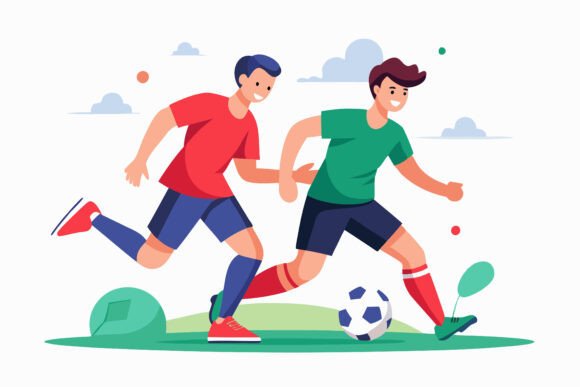
For those seeking a resource that truly meets professional demands, look for collections designed with the user’s workflow in mind. A notable example is the AI EPS illustration set featuring soccer players running with ball. Here is what elevates it beyond ordinary options.
- Versatile File Formats Included: The package contains AI EPS and high-quality JPG files. This ensures compatibility across Adobe Illustrator and other vector software, while also providing a ready-to-use raster option for quick placement in presentations or social media.
- Cross-Platform Compatibility: Designed for both Mac and Windows users, the files eliminate operating system headaches. No conversion issues, no missing fonts—just immediate integration into your design environment.
- Organized File and Layer Structure: Every element is logically named and grouped. You don’t waste time hunting for a specific limb or shadow; the neatly organized layers let you isolate components in seconds.
- Perfection in Details and Consistency: The vector artwork maintains uniform line weights, anatomically accurate player poses, and consistent styling throughout the collection. This means your brochure, website, and printed banner all share the same professional polish.
- Broad Suitability Across Channels: The illustrations work flawlessly for print projects, digital web assets, mobile symbols, app interfaces, and detailed infographics. Color fidelity remains sharp whether scaled to a massive billboard or a tiny icon.
- Complete Editability: Need to recolor a uniform to match team branding? Adjust the ball position for a custom drill diagram? The editable vectors let you change colors, modify contours, and tweak details with full creative freedom. No rigid limitations.
These features streamline the creative process significantly. Instead of spending hours searching for and cleaning up imperfect images, you can start with a robust, ready-to-adapt foundation. The ability to resize without quality loss, combined with layer-based editing, makes this kind of collection a practical investment for any serious designer or coach producing visual content about the beautiful game.
Practical Applications in Modern Sports Communication
Consider a sports analytics startup that needs to populate its interface with dynamic player silhouettes to represent different data points. Using the editable Ai EPS figures of soccer players running with ball, developers can quickly generate sprint icons, dribble indicators, or heat-map overlays that remain legible at any resolution. Coaches preparing a playbook can insert action sequences into PDFs, rotating and repeating characters to illustrate drill progressions. Even large-scale stadium graphics benefit from such vectors—blown up to wall size, the lines stay crisp and professional.
For education, a skills academy might print posters showing proper running form. The layered EPS allows isolating just the skeletal motion lines, making technical analysis accessible to young learners. Digital publishers can use the same illustrations across articles, apps, and video thumbnails without worrying about mismatched styles or usage rights. Consistency across platforms builds brand authority and viewer trust.
Integrating Action and Imagery for Maximum Impact
The synergy between on-field movement and off-field design might seem subtle, but it directly affects how audiences connect with the sport. A beautifully rendered vector of a player mid-stride captures the tension and grace that words alone can’t convey. When you combine that visual with informed commentary about technique, you create content that engages both the analytical and emotional sides of fans. The illustration becomes more than decoration—it serves as a precise communication tool.
From a creator’s standpoint, having an organized, editable asset library gives you the agility to respond to content needs immediately. Whether you need to highlight a key moment from a weekend match or build a season-long visual campaign, starting with professional-grade vectors of soccer players running with ball ensures your output always looks elite. The flexibility to recolor and restyle keeps visuals fresh for different themes, tournaments, or sponsor requirements.
Selecting the Best Resource for Your Projects
When evaluating an illustration set, prioritize those that offer not just aesthetic appeal but also structural integrity. The file organization behind the scenes matters greatly. An AI EPS set that arrives with clearly labeled layers—distinguishing background, player figures, and action lines—saves hours of extraction work. Similarly, cross-platform readiness means you can hand files to a colleague on a different operating system without a hiccup. The combination of vector and JPG formats ensures you’re ready for both high-end print production and quick digital mockups.
In the realm of soccer-focused visual assets, a collection centered on running exploits reflects the sport’s most exhilarating moment. It resonates with audiences because running with the ball embodies ambition, artistry, and the relentless pursuit of progress. By embedding that energy into your projects through expertly crafted illustrations, you communicate instantly and powerfully.